
@internetofshit
@internetofshit
It may come as a surprise to these radical YeeHawdists that “private property” is a government created concept.
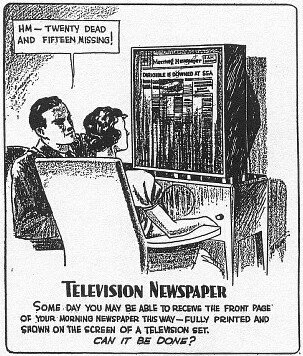
Television newspaper
Some day you may be able to receive the front page of your morning newspaper this way — fully printed and shown on the screen of a television set.
Can it be done?

Radio set prints newspaper.
Chair of the UN Human Rights Council, Saudi Arabia, to open investigation into human rights abuses by Saudi Arabia.
Now do you see why Australia wants a seat at this table? http://foreignminister.gov.au/releases/Pages/2015/jb_mr_151019.aspx
Jihadism : not really so hard to understand. It’s politics by other means.
Originally shared by Jeff Zahari
“Terrorism studies, even in a more evolved form claiming to transcend Islamophobia, remains trapped in an unwillingness to raise challenging questions. Without rendering legible the political nature of jihadi projects, its focus on doctrine becomes deterministic; its analysis of propaganda tends toward voyeurism; its study of tactics redounds to incoherent moralism; and its focus on individual motivations is atomistic. This is not a matter of the failings of individual analysts but rather is a feature of this body of work as long as its raison d’être remains raison d’état.”

That’s cold, Turkey.
Joke stolen from Christian Nalletamby
Originally shared by ****
Happy New Year , Turkey ! 🙂
I hadn’t seen dot matrix skywriting before. They still use the old analog method around here.
Now I want to see a few different fonts.
Interesting article by Josh Marshall
Originally shared by ****
[T]hat obscures what is in many ways a much truer, historically meaningful and telling comparison: high murder rates as a phenomenon of the Americas.
[…]
This brings us back to the US crime rate and particularly the Southern murder rate. Why has the South always had a much higher murder rate than the rest of the country? The answer seems obvious: slavery. The role of violence and labor is much, much more similar to the Greater Caribbean than any other part of the United States. And when we look at the relatively high rates of violent crime among African-Americans, though this is a highly fraught and complex question, the sort of alienation from police authority, which goes far, far back into our history, is in my mind almost certainly a central part of the story.
In any case, let’s circle all the way back to what are still the relatively high rates of violence and murder in the US versus Europe and some other parts of the world. Some of the mystery is simply that our frame of reference is wrong. The United States is part of the Americas and not just in the obvious geographical sense. While it is distinct in many ways, the US (and not just the South) had its fundamental origins as a settler society, which created basic patterns which are still with us today.
 Never Stop Posting