
The story that it just spontaneously emerged from China’s industrial complex turns out to be a myth. The original “hoverboard” didn’t come from China but its inventor did.
Month: January 2016
Finally got around to reading Paul Graham’s inequality essay.
Finally got around to reading Paul Graham’s inequality essay. It’s not as obnoxious as it has been depicted by some but there are some aspects that I strongly disagree with. Because of the rambling nature of Graham essays, his main points got lost and were prone to misinterpretation so he wrote a shorter summary version which is probably the better one to start with http://paulgraham.com/sim.html
Graham argues that people who are concerned about poverty are wrong to focus on inequality and tries to demonstrate that these two things are separate concerns which shouldn’t be linked. He acknowledges that poverty is a problem and even hints that it could be reduced via some redistributive means (ie. taxes) but he does not want to demonize inequality per se because he sees the gradient of wealth as an important economic motivator. The desire to get wealthy he argues is what drives entrepreneurs to create new businesses and (in theory) enrich the whole of society*. He is quick to distinguish this kind of activity from the predatory zero-sum activities of Wall Street (although I’m certain that a similar argument could be made by one of its advocates to justify at least some of its activity is also a social good).
So if poverty is an evil that exists in separation from the presence or absence of self-made wealthy individuals, what is the correct position to take? Here Graham is not saying anything strikingly new but falls back on what I would consider the standard liberal position pre-2008 pre-GFC pre-Occupy Wall Street: it is not inequality that should be addressed but inequality of opportunity. Each person regardless of their position in society should have access to the same opportunities to get rich. This implies investment in education and unhindered access to information technology. It implies that if opportunity is available then social mobility will do the rest. In a society where poverty has been addressed, everyone has the chance—if they are smart enough and driven enough—to get “funded” and go on to start a business and get incredibly wealthy. If the difference between the rich and not so rich wasn’t big then these people might just go and get a job. This would be a net loss to society because new businesses increase the size of the pie for the whole society.
By separating poverty from inequality, Graham overlooks a few things. He recognises that inequality was less when he was growing up but doesn’t realise that social mobility has all but stopped or even reversed for many people. In fact the gradient of inequality has had a direct impact on social mobility. Rather than serving as an incentive to work harder, it has merely served to increase the power and influence of the wealthy (not least through their stranglehold over society’s political institutions) and put a break people moving upward. It has got to the point now where most wealth is not made by individuals within a single generation but is far more likely to have been obtained through inheritance. The best way in this new Guilded Age to make money is not to get funded by the likes of Graham but via the more traditional route of “marrying well”.
Graham doesn’t see that the 1960s of his youth were historically atypical, that social mobility and easy access to middle class capital and opportunity is increasingly becoming harder to obtain. The reason for this is that, despite the wishful thinking of well-meaning liberal plutocrats, poverty and growing inequality are inextricably linked. One cannot understand poverty in absolute terms without also looking at it in relative ones. Poverty is not a problem that can be simply separated from the existence of fabulously wealthy people. They are the two sides of the same coin.
* it is also questionable whether the wealth differential is actually the prime motivator for enterprise. People are driven by many things.
I’m really going to have to do something about my klout score.
I’m really going to have to do something about my klout score.
Originally shared by Tom Higgins
Social Credit … You Are Soaking In It
Setting a social metric based on what you buy, what you post, who you have in your social network on and offline…this is not an invention by the Chinese state but an idea they have lifted from governments/corps that have been working to improve it for years.
Look around.
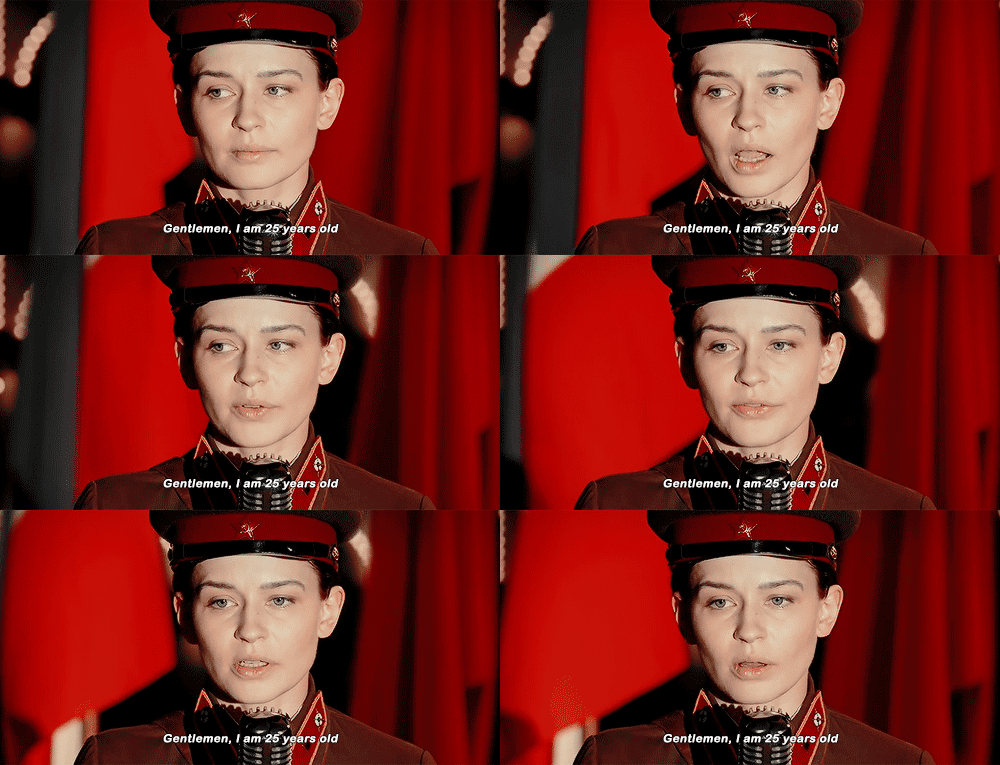
Lyudmila Pavlichenko (1916 – 1974) was a Soviet sniper during World War II.
Lyudmila Pavlichenko (1916 – 1974) was a Soviet sniper during World War II. Credited with 309 kills, she is regarded as the most successful female sniper in history.
In June 1941, 24-year old Pavlichenko was in her fourth year of studying history at the Kiev University when Nazi Germany began its invasion of the Soviet Union. Pavlichenko was among the first round of volunteers at the recruiting office, where she requested to join the infantry and subsequently she was assigned to the Red Army’s 25th Rifle Division. In June 1942, Pavlichenko was wounded by mortar fire.
Because of her growing status, she was pulled from combat less than a month after recovering from her wound. Pavlichenko was sent to Canada and the United States for a publicity visit. By Chicago, she stood before large crowds, chiding the men to support the second front. “Gentlemen, I am 25 years old and I have killed 309 fascist occupants by now. Don’t you think, gentlemen, that you have been hiding behind my back for too long?” After a short pause, the crowd met her statement with great approval.


The Anime-ification of the human race continues unabated.
The Anime-ification of the human race continues unabated.
Originally shared by Peter da Silva
What could possibly go wrong?
“My pupils do not dilate any more and I feel like I’m a vampire.”
“You have to use anti-inflammatory drops for the rest of your life.”
Oh, OK, no biggie.
You may recall that wage fixing cartel agreement between Apple and Google a few years back.
You may recall that wage fixing cartel agreement between Apple and Google a few years back. It seems that Jobs learned the game from George Lucas.
In an era of universal suffrage, elite interests rule by manipulating public opinion through misinformation.
In an era of universal suffrage, elite interests rule by manipulating public opinion through misinformation. Increasingly we are living under a dictatorship of ignorance. Unless this deliberate spreading of ignorance can be countered* somehow it seems likely that this process will ultimately destroy our civilisation.
* by other elite elements?
Originally shared by Tom Higgins
Life During Fudtime
“It comes from agnosis, the neoclassical Greek word for ignorance or ‘not knowing’, and ontology, the branch of metaphysics which deals with the nature of being. Agnotology is the study of wilful acts to spread confusion and deceit, usually to sell a product or win favour.”
Vanilla ISIS is hungry.

Vanilla ISIS is hungry.
The Y’alliphate
The Y’alliphate
“I really dig old Trump, whose head has a gigantic hole and who won’t stop his sensational remarks”
“I really dig old Trump, whose head has a gigantic hole and who won’t stop his sensational remarks”
 Never Stop Posting