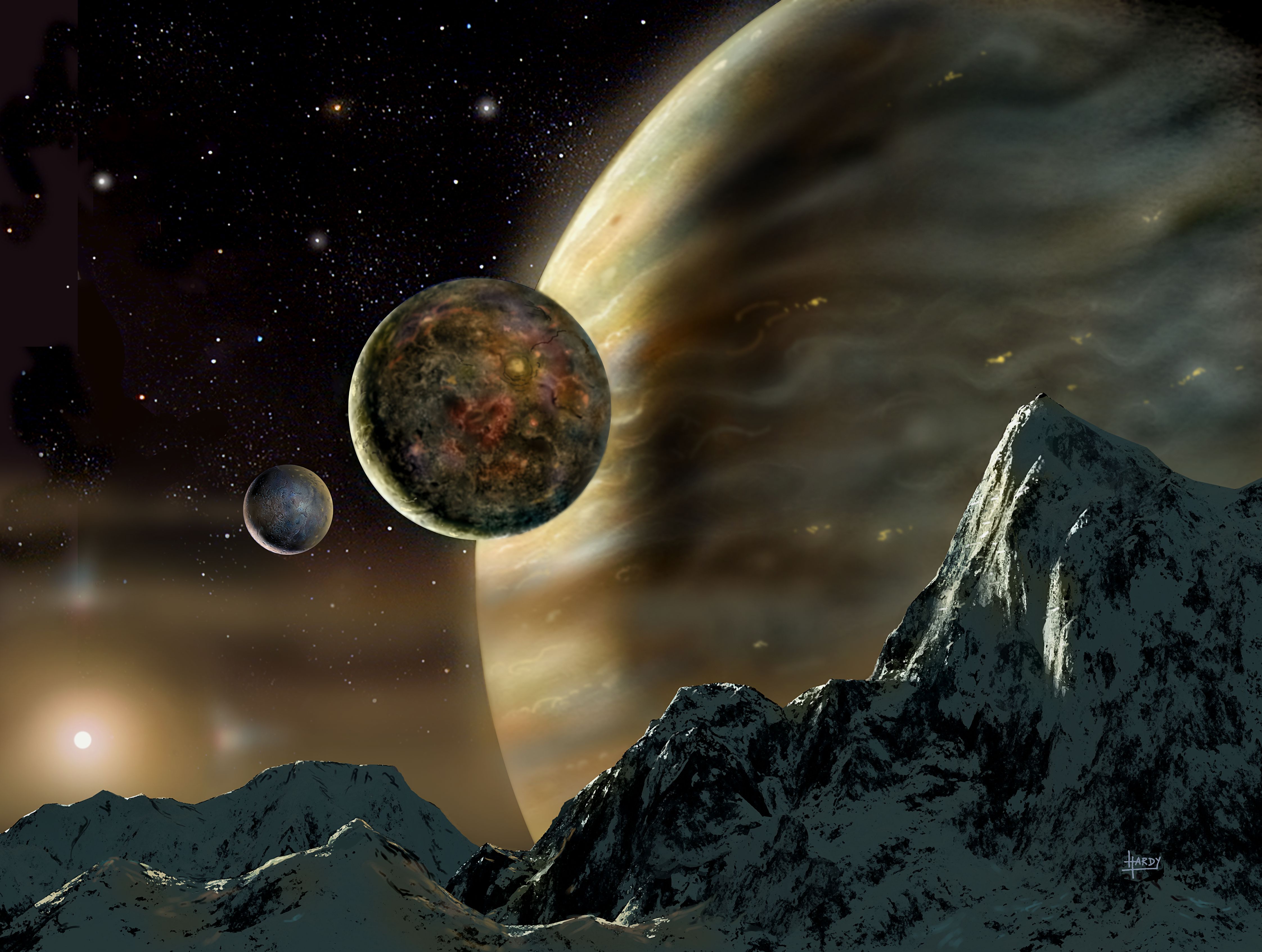
Home away from home


image of a possible scene from a moon orbiting the extra-solar planet

The
image shows an impression by David A. Hardy of a possible scene from a
moon orbiting the extra-solar planet in orbit around the star HD70642.
The planet has a mass about twice that of Jupiter and orbits the star
in roughly six years, with a nearly circular orbit of more than three
times the Earth-Sun distance. The star HD70642 is a 7th magnitude star
in the southern constellation Puppis, and has properties very similar
to that of our sun. The similarity in appearance of the extra-solar
planet to Jupiter arises because the planets have a similar mass. The
possible existence of the moons has been inferred from our knowledge of
the planets in our own solar system and from theories of planetary
formation—they have not actually been detected.


The 'orbit' diagram shows the size and shape of the star HD70642 orbit compared with the orbits of planets in our own Solar System
The ‘orbit’ diagram shows the size and shape of the
star HD70642 orbit compared with the orbits of planets in our own Solar
System

Illustration of the
Doppler Wobble Technique.

Astronomers looking for planetary systems
that resemble our own solar system have found the most similar formation
so far. British astronomers, working with Australian and American
colleagues, have discovered a planet like Jupiter in orbit round a
nearby star that is very like our own Sun. Among the hundred found so
far, this system is the one most similar to our Solar System. The
planet’s orbit is like that of Jupiter in our own Solar System,
especially as it is nearly circular and there are no bigger planets
closer in to its star.

“This planet is going round in a nearly circular orbit three-fifths
the size of our own Jupiter. This is the closest we have yet got to a
real Solar System-like planet, and advances our search for systems that
are even more like our own,” said UK team leader Hugh Jones of Liverpool
John Moores University.

The planet was discovered using the 3.9-metre Anglo-Australian
Telescope [AAT] in New South Wales, Australia. The discovery, which is
part of a large search for solar systems that resemble our own, will be
announced today (Thursday, July 3rd 2003) by Hugh Jones (Liverpool John
Moores University) at a conference on “Extrasolar Planets: Today and
Tomorrow” in Paris, France.

“It is the exquisite precision of our measurements that lets us
search for these Jupiters – they are harder to find than the more exotic
planets found so far. Perhaps most stars will be shown to have planets
like our own Solar System”, said Dr Alan Penny, from the Rutherford
Appleton Laboratory.

The new planet, which has a mass about twice that of Jupiter,
circles its star (HD70642) about every six years. HD70642 can be found
in the constellation Puppis and is about 90 light years away from Earth.
The planet is 3.3 times further from its star as the Earth is from the
Sun (about halfway between Mars and Jupiter if it were in our own
system).

The long-term goal of this programme is the detection of true
analogues to the Solar System: planetary systems with giant planets in
long circular orbits and small rocky planets on shorter circular orbits.
This discovery of a -Jupiter- like gas giant planet around a nearby star
is a step toward this goal. The discovery of other such planets and
planetary satellites within the next decade will help astronomers
assess the Solar System’s place in the galaxy and whether planetary
systems like our own are common or rare.

Prior to the discovery of extrasolar planets, planetary systems were
generally predicted to be similar to the Solar System – giant planets
orbiting beyond 4 Earth-Sun distances in circular orbits, and
terrestrial mass planets in inner orbits. The danger of using
theoretical ideas to extrapolate from just one example – our own Solar
System – has been shown by the extrasolar planetary systems now known to
exist which have very different properties. Planetary systems are much
more diverse than ever imagined.

However these new planets have only been found around one-tenth of
stars where they were looked for. It is possible that the harder-to-find
very Solar System-like planets do exist around most stars.

The vast majority of the presently known extrasolar planets lie in
elliptical orbits, which would preclude the existence of habitable
terrestrial planets. Previously, the only gas giant found to orbit
beyond 3 Earth-Sun distances in a near circular orbit was the outer
planet of the 47 Ursa Majoris system – a system which also includes an
inner gas giant at 2 Earth-Sun distances (unlike the Solar System). This
discovery of a 3.3 Earth-Sun distance planet in a near circular orbit
around a Sun-like star bears the closest likeness to our Solar System
found to date and demonstrates our searches are precise enough to find
Jupiter- like planets in Jupiter-like orbit.

To find evidence of planets, the astronomers use a high- precision
technique developed by Paul Butler of the Carnegie Institute of
Washington and Geoff Marcy of the University of California at Berkeley
to measure how much a star “wobbles” in space as it is affected by a
planet’s gravity. As an unseen planet orbits a distant star, the
gravitational pull causes the star to move back and forth in space. That
wobble can be detected by the ‘Doppler shifting’ it causes in the
star’s light. This discovery demonstrates that the long term precision
of the team’s technique is 3 metres per second (7mph) making the
Anglo-Australian Planet Search at least as precise as any of the many
planet search projects underway.

[Astronomers
find ‘home from home’ – 90 light years away!
]

See also:

Scientists
Discover Planetary System Similar to Our Own

Hakka

Contributing yet another strand to the patchwork of overseas
Chinese speech and customs were the Hakkas, latecomers to the
southernmost provinces, moving into Fukien and Kwngtung in two separate
migrations: during the tenth century and the twelfth and thirteenth
centuries. The Hakkas whose name means `guest families’ have been
described as the gypsies of China, people who live side by side with
speakers of different dialects in enclaves scattered across six southern
provinces, without a homeland of their own. They were a rugged lot, and
even their women had to be hardy. Little wonder that the Hakkas were
the only Chinese to refrain altogether from binding their daughters’
feet into the `golden lilies’ that were de rigueur everywhere else. One
thing Hakka women were not was dainty.

Men moving across great distances into an unknown landscape,
assailed by the hostility of settlers who have preceded them, band
together; and if Hakkas were (and still are) thought a very clannish
people, they had good reasons to be. The banding-together took a
palpably defensive form, in communal living and communal housing Their
dwellings, still to be seen today in a border area in Fukien province,
are extraordinary constructions, rising out of the countryside like
veritable fortresses, gigantic, multi-storied, round. They are built to
a circular plan, with a thick outer wall of tamped earth pierced by
tiny squint-holes, presenting a resolutely sealed and embattled look to
the world. In the walled complex, an entire community, numbering six to
seven hundred inhabitants, could be concentrated.

It was no easy matter to live among the Cantonese, to contend for
land and water. Feuds were easily ignited in such an atmosphere, and
there evolved a tradition of armed fighting between the migrant and the
settler. We read of a period of prolonged fighting between the two in
the years 1855-67, a war in which about half a million people are said
to have lost their lives. It is not hard to see why the Hakkas
emigrated to Nanyang [South-East Asia]. In China they were pushed on to
marginal land, hilly country rejected by those who had got there first.

[from Sons of the
Yellow Emperor : The Story of the Overseas Chinese
by Lynn Pan,
Mandarin Paperbacks 1991, page 16]

Here are some pictures of traditional Hakka round earth builidings (click to get a higher resolution version).

Round Earth Building


This type of building is round in shape and divided into
three classes, small, medium and big. The small ones are usually 2 to 3
stories tall with a single ring. The medium dwelling is usually 3 to 4
stories tall with a large inner open space (single ring) or double
rings. The large round building is usually 4 to 5 stories tall
consisting of as many as three rings.

The very small round building has
about 12 to 18 rooms, the small ones have 21 to 28 rooms, the medium
ones have about 30 to 40 rooms, the large ones have about 42 to 58
rooms, and the super large round buildings have about 60 to 72 rooms.

Two-third of the round building are 3 stories high and hold roughly 20
families or 100 people. The round earth building is a “group-oriented”
residence, usually with one main entrance. Its wall is usually around 1
meter thick. The main entrance door is padded with iron sheet and is
locked by 2 horizontal wood bars. The wooden bars retract into the walls
in order to open the door. In the event the wood bars are sawed through,
the locking mechanism is still intact.

Inside the entrance is a huge
central courtyard where all the doors of the rooms and inner windows are
open to. At the ground level except the hall and the staircases, the
rooms are used as kitchens and dining rooms. The rooms on the second
floor are used for storage. The rooms on the 3rd level are used as
bedrooms. The rooms in each level are identical. In front of each room,
there is an open round hallway and usually there are 4 staircases to
move from one level to another. Thus each family occupies one vertical
units with lower level as kitchen, 2nd level for storage and
miscellaneous use and 3rd level and above used as bedroom. Sometime
there is no open round hallway. Instead, every family has its own
private staircase. A typical room is about 10-13 square meter in size.

The larger round earth building has room around 15 square meters. The
windows facing outside tends to be small, with the window size at the
outer wall smaller and the window size at the inner wall larger enabling
wider surveillance from the inside. It is extremely hard for outsiders
to come in through the windows. There is usually no window at the ground
level. While the round building is fairly large, it has an inner ring,
which is like a round building within a round building. For round
building that built earlier than 15th century, they have other defensive
features that would counter siege. It is said that during Ming dynasty
as Japanese pirates intruded the coastal areas, they always leave the
Hakka’s Earth Buildings area alone.

[Hakka – An Important Element of Chinese Culture]

Japan claims title to world’s first bicycle

The world’s first bicycle was developed by a Japanese feudal lord in
1732, a model recently created on the basis of a Edo-Period drawing has
suggested.

A 30-centimeter-long scale model of a
bicycle designed in 1732.

Toshio Kajiwara, 60, a former bicycle company technical adviser,
analyzed the drawing of a “newly-developed, boat-style ground vehicle,”
and Kenjiro Kawakami, professor of industrial archeology at Tama
University of Arts, created a 1/5 scale model.

“Our discovery that a bicycle with pedals existed in Japan in the
1730s has drastically changed the history of bicycles,” Kajiwara said.

It has been widely believed that the first bicycle was invented in
France in 1861.

“The pedal structure of the ‘newly-developed, boat-style ground
vehicle’ is identical to that of bicycles. However, it did not spread
throughout Japan probably because most of the roads in the country were
bumpy at the time,” Kawakami, president of the Japan Industrial
Archeology Society, said.

The drawing is in a document compiled by Kuheiji Hiraishi (1696 to
1771), the lord of the Hikone feudal clan in Shiga Prefecture. It is
preserved at the Hikone Municipal Library.

The document says that a so-called “boat-style ground vehicle”
developed by a farmer living in the Kodama district of Bushu (currently
the Saitama Prefecture city of Honjo) became popular in Edo (Tokyo).

It shows that the vehicle could climb up slopes. One of Hiraishi’s
retainers living at the clan’s Edo residence reported the vehicle to the
lord who was also a scientist.

Since the vehicle’s mechanism was unclear, Hiraishi designed his own
boat-style ground vehicle and built it in 1732, the document says.

The vehicle comprises of a boat-shaped wooden body, a single front
wheel and two rear wheels. The pedals are connected to a disk that
resembles a flywheel with an iron rod similar to a crankshaft.

The document claims that it ran at about 14 kilometers per hour.

[Mainichi
Shimbun
]

Hardware requirements

Greetings,

We need a vendor who can offer immediate supply.
I’m offering $5,000 US dollars just for referring a vender which is
(Actually RELIABLE in providing the below equipment) Contact details
of vendor required, including name and phone #. If they turn out to be
reliable in supplying the below equipment I’ll immediately pay you
$5,000. We prefer to work with vendor in the Boston/New York area.

1. The mind warper generation 4 Dimensional Warp Generator # 52 4350a
series wrist watch with z80 or better memory adapter. If in stock the
AMD Dimensional Warp Generator module containing the GRC79 induction
motor, two I80200 warp stabilizers, 256GB of SRAM, and two Analog
Devices isolinear modules, This unit also has a menu driven GUI
accessible on the front panel XID display. All in 1 units would be
great if reliable models are available

2. The special 23200 or Acme 5X24 series time transducing capacitor
with built in temporal displacement. Needed with complete
jumper/auxiliary system

3. A reliable crystal Ionizor with unlimited memory backup.

4. I will also pay for Schematics, layouts, and designs directly
from the manufature which can be used to build this equipment
from readily available parts.

If your vendor turns out to be reliable, I owe you $5,000.

Hiatus

Hi*a”tus (?), n.; pl. L. Hiatus, E. Hiatuses (#). [L., fr. hiare, hiatum, to gape; akin to E. yawn. See Yawn.]

1. An opening; an aperture; a gap; a chasm; esp., a defect in a manuscript, where some part is lost or effaced; a space where something is wanting; a break.

2. (Gram.) The concurrence of two vowels in two successive words or syllables. Pope.

[Webster Dictionary, 1913]

Well, that’s not exactly what I meant but it’s close enough. I’m going to be taking a bit of a breather from the blog so there won’t be any posts here for a couple of weeks.

Let me leave you with this delicious recipe that I discovered whilst Under the Fire Star.

I really love South Indian food, I only wish that there were some restaurants here in Melbourne that knew how to cook it1.

The cornerstone of this cuisine is undoubtedly the humble sambar.

Sambar

Ingredients:

Vegetable 1/4-1/2 kg
New tamarind – a lump the size of a small lime
Red gram dhal (toor dal) 2/3 cup
Turmeric powder 1/2 tsp
Gingelly (sesame) oil 3 tsp (my note: or use any cooking oil)
Dry red chillies 10 (Medium) or 6 (Large)
Green chillies 2
Mustard seeds 1/2 tsp
Fenugreek seeds 1/2 tsp
Asafoetida powder – a pinch or to taste
Curry leaves (Chopped) 3 tbsp
Salt 1 tsp
Rice flour 1/2 tsp
Coriander leaves (Chopped) 3 tbsp

To serve 4 persons

A variety of vegetables — drumstick, lady’s finger (okra), onion,
brinjal (eggplant), pumpkin, carrot, French beans, runner beans, etc, —
can be used to prepare sambar. Select any one vegetable. Cut into
medium size bits and wash. Vegetables like onion, brinjal, lady’s
finger, French beans, runner beans and cluster beans can also be fried a
little before adding. Amaranth stems, radish, runner beans, cluster
beans or pumpkin may be cooked separately with just enough salt and then
added.

Soak the tamarind in 1 cup water for 20 minutes. Squeeze it out, adding
water little by little to prepare 1 cup of juice.

Choose a heavy vessel, e.g., stoneware, with a very narrow mouth. Wash
the dhal. Clean and remove stones, if any. (If the dhal is cleanly
husked, it need not be washed.) Boil 1 to 1 1/4 cups of water. Add the
dhal, turmeric powder and 1 tsp oil. Cover with a shallow lid, filled
with water. (A cup of water may also be placed on the lid.) Add this
water to the dhal, if needed,while the dhal is cooking. Cook till very
soft. (Some dhals do not cook soon. If so, add a pinch of baking soda.
If baking soda is added, do not use turmeric powder, as the colour of
the dhal will be spoilt.) Remove from fire and mash the cooked dhal.
Keep aside.

Heat a vessel. pour in the remaining oil. Pinch red chillies into
halves. Slit green chillies. Fry the pinched red chillies, mustard,
fenugreek seeds and asafoetida to a dark brown colour (without
blackening it). Add green chillies. Pinch curry leaves and fry for a few
moments. Add the tamarind juice to the seasonings with salt. Add the
cut and washed vegetable.

When the vegetable is cooked in the tamarind juice, add the mashed
dhal. Allow it to boil well. Mix the rice flour in water. Add and stir
well. Bring to boil once more. Boil for a few minutes. Remove from fire.
Garnish with coriander leaves and a few curry leaves.

Note: Asafoetida water may be used in the place of asafoetida powder.
If using asafoetida water, add to the sambar when boiling. To prepare
thicker sambar, increase the quantity of dhal. The dhal can be cooked in
a pressure cooker as well.

1 – actually the reason why nobody makes it here was explained to me by a restaurant proprietor who gave me a crash course in curry economics. Sambal is a really thin sauce which goes with mountains of rice or is mopped up with roti. Customers are only willing to pay for curries with thick gravies, hence all the friggin’ kormas. This law of currynomics also dictates that there will be a predominance of rendangs at Malaysian restaurants.

The only way I can think of breaking this nexus is to import a large number of South Indians to Australia. The idea is to build a large domestic market of people uninfluenced by weird Anglo prejudices against rice and roti (and for that matter complex carbohydrates in general). Expert roti makers should, as part of these reforms, have their visa applications fast-tracked.

You may have already guessed that I have a number of other cuisine-related immigration policy ideas that I’m likely to share with you one day.

2Pauline Hanson was a fish ‘n’ chip shop proprietor (actually there is no point 2 to go with this footnote).

Eclipses and Pinhole Sundials

Pinhole sundials are just the sort of wonderful devices that one
might find in a cathedral built during the Renaissance.

The sundial works by
focussing the sun’s rays into a bright spot on the church’s floor. The
movement of this spot marks the course of the day.

The interesting
aspect here is that the shape of the spot is not simply due to the shape
of the hole that it passes through. The hole is so small that it actually acts like a
lens and what is displayed is really an inverted image of the
sun itself. It works just like a giant pinhole camera.

This becomes more apparent when the spot is observed during a solar
eclipse…

[more]

reposted for the Collaboratory

MEMS Pinball


Scientists in Sweden have developed a novel technique for making
micromachines and demonstrated its potential by making a micro pinball
table in which silicon cantilevers acted as the ‘flippers’, magnetic
beads 150 microns in diameter were the balls, and the table measured 25
millimetres square.The table was tilted at an angle of 20 degrees to the
horizon.

They found that the speed of a ball could reach up to 0.75 kilometres
per hour – or 210 000 microns per second. This is equivalent to a
football having an almost supersonic speed of 1125 km per hour (see a movie
of the action).

“The pinball games are used for demonstrating this simple and easy
process,” says researcher Martin Bring. “It also demonstrates some of
the effects that occur on the micrometer level, such as small apparent
inertia.”

[more]