Back again

Yes there’s movement at the station once again finally.

I’m moving Laputan Logic over to a new completely dog-food-compliant website which is located at www.laputanlogic.com. All updates will occur there for now on, so please update your bookmarks and if you have one of those websites that is kind enough to link to me, please update your blogroll as well.

I must say I’m pretty happy with the new format which I hope will enable me to update more frequently but at the same time keep the stuff I have spent more time working on from being pushed too far down the page. I must confess I have been struggling to find the right mix with the blog format. I think this should be a major improvement and I hope you will like it as well.

Here’s a sample of why you should be heading there RIGHT NOW:

A Roman in the Indies

In 550 AD, during the reign of Emperor Justinian, a monk who was cloistered at a remote monastery in the Sinai
desert wrote a curious book about the topology of the earth and the
universe. In the book the monk, who is know to posterity as Cosmas
Indicopleustes, propounded a surprising theory that the
world was not
spherical
as believed by the ancients but, on the contrary, was flat and surrounded by
four
walls
which stretched up to the heavens and formed a curved lid.

Scholarship has not been terribly kind to the work of Cosmas
Indicopleustes. Even in his own time he had to staunchly defend his
theory
against strong criticism. By his own admission he was not well
educated in the “learning of schools” and his unfortunate practice of
distorting passages of
scripture in order to support his argument led to his work being
largely dismissed by his contemporaries and then
disregarded by later generations. While we too can easily dismiss
his eccentric notions which seem to be more the product of pious
daydreaming than any kind of scientific investigation or empirical observation,
on closer inspection there is another rather more interesting side to Cosmas.

Thirty years before writing his book, Cosmas had led a life very
different from the serene austerity of a desert cloister. Cosmas
Indicopleustes actually means “Cosmas the India Voyager” and back then the monk was a merchant
who had traveled extensively around the coasts
of the Red Sea and the Indian Ocean. Buried
deep under ten volumes of questionable scholarship which
comprises the bulk of his Topology we find a surprising and
particularly
lucid account of his travels to these countries. This
eleventh volume

bears little relationship to the
earlier parts of the book and it is thought to have been excerpted from
another larger work
of his on geography which has, sadly, been lost.

While its known that the Roman
world engaged in
trade with the Indian subcontinent
,
Cosmas offers us one of the only
authentic eyewitness accounts. A close reading indicates that he had
considerable local knowledge of the regions he describes and there
is little doubt that he actually visited these places rather than
merely
relating second-hand information.

He begins his geographical treatise by describing the unusual flora and fauna of
Africa and Asia. Here are some excerpts:


Rhinoceros
This animal
is called the rhinoceros from having horns upon his snout. When he is
walking his horns are mobile, but when he sees anything to move his
rage, he erects them and they become so rigid that they are strong
enough to tear up even trees by the root, those especially which come
right before him. His eyes are placed low down near his jaws. He is
altogether a fearful animal, and he is somehow hostile to the elephant.
His feet and his skin, however, closely resemble those of the elephant.
His skin, when dried, is four fingers thick, and this some people put,
instead of iron, in the plough, and with it plough the land.

The Ethiopians in their own dialect call the rhinoceros Arou, or Harisi, aspirating the alpha of the latter word, and adding risi. By the arou they designate the beast as such, and by arisi,
ploughing, giving him this name from his shape about the nostrils, and
also from the use to which his hide is turned. In Ethiopia I once saw a
live rhinoceros while I was standing at a far distance, and I saw also
the skin of a dead one stuffed with chaff, standing in the royal
palace, and so I have been able to draw him accurately.

The accuracy of Cosmas’ drawing of the rhinoceros leaves a fair bit to be desired but apparently the word arou that he gives as the name of the two-horned rhinoceros is still used in Ethiopia to this day.
Dog chow for brekky

As I implied in an earlier post I have been working on software that will enable me to manage my own website. This software is part of a suite of products that we’re developing at Lagado which covers things like content management and site maintenance and goes all the way through to publishing to web or print.

So it’s tad ironic that Laputan Logic has up to now been maintained using someone else’s code. I’m not complaining about Blogger which I think has improved dramatically of late1 but I’ve been thinking it’s high time that I start to practice what I preach or, to borrow some industry parlance, its time to start eating my own dog food.

New developments to follow shortly…


1 – okay, okay, I’ll admit it was pretty rugged before that.

Update on the Third Buddha

It now appears that Japanese archaeologists are also on the case to find the missing third Bamiyan Buddha. This looks like it’s heating up to be a race to see who finds it first.

My bet is that the only thing left to find will be its stone foundations.

Japanese team to probe Bamiyan

A team of Japanese experts departed Saturday afternoon for Afghanistan
on a mission to search for an image of a supine Buddha in Bamiyan.

The team will attempt to confirm the existence of the supine Buddha
that is rumored to be located somewhere in the region by using
high-tech devices such as radar capable of locating buried artifacts.

Xuanzang (602-664), a Chinese Buddhist monk, described the artifact in
his book “The Records of the Western Regions of the Great Tang
Dynasty”: “Inside a Buddhist temple located about 10 kilometers from
the palace, there is a statue of Buddha in a state of passing into
nirvana. The image of the supine Buddha is as long as 300 meters.”

He also wrote in his book: “There is a stone image of a standing Buddha
carved into the mountainside northeast of the palace. Shining in gold,
and adorned with jewelry, the statue stands about 45 meters tall. To
the east of the temple, stands another statue of a 30-meter-tall Buddha
made with brass.”

The statues he described in the book are believed to be the two Buddha
statues that were destroyed by Afghanistan’s former Taliban rulers in
March 2001.

The research team considers that the description of the statues in
Xuanzang’s book is highly accurate, and the information concerning the
existence of a supine Buddha is credible. It is believed that the
palace and the temple are buried underground. No fact-finding probes
have been conducted of the area due to the country’s protracted
conflicts.

The project to probe for the image of the supine Buddha was
commissioned by Japan’s National Research Institute for Cultural
Properties. Eight researchers mainly from the institute will examine
the area from Monday through Oct. 22.

The research team will use a ground-penetrating radar to determine the
location of buried items and hollows under the ground, allowing the
team to determine the size of the entire archaeological site before
excavating it.

The radar emits electromagnetic waves into the ground using an antenna
that can detect energy emitted from buried objects.

Researchers will use the radar at about 50-meter intervals over a
1.3-kilometer area from east to west, as well as 300 meters north-south
of the two destroyed statues.

The image of the supine Buddha is believed to be located between the
two statues.

“I don’t think the image of the supine is as big as Xuanzang described
in his book. It will probably be about 30 meters long, not 300 meters
as he described,” said Kazuya Yamauchi, the team’s chief researcher.

Yamauchi said if the statue was as long as 300 meters, it should
already have been discovered.

“I’m worried about whether the radar can detect the statue underground
if it’s not that big,” he said.

The possibility that the image of the supine Buddha remains in the same
condition as Xuanzang saw it in the 7th century is low, and it is
highly probable that even if it is discovered, it will be damaged to
some extent.

“If we succeed in discovering traces of the site, it will definitely be
the key to finding out more about the former Bamiyan kingdom,” Yamauchi
said.

“The statue of the image of the supine Buddha will attract
international attention, and it’s a dream for those engaged in
archaeology. I hope the Japanese research team can discover it,” said
Kosaku Yamada, professor emeritus of Wako University…

[link]

…before the French do.

Blogger Trick

Yes, yes, we all know that Moveable Type is
the way to go etc. although to be frank I’m telling you right now I’m not going to install
any software to manage my blog that I didn’t write myself. This is
something that is definitely on the cards for some day soon but in the
meantime for those few people who are so uncool as to be still using
the venerable Blogger I thought
I’d share a little thing that I learnt the other day which may be of
interest…

For quite a while now I have been running in the right hand column a
list of the headings for the posts that appear on the page (see the “Heads Up” list). This I
think is a convenient indicator for people to quickly see what has
changed or to spot something they may have missed. Any way I like it
and all the groovy MT blogs have a “recent posts” list a bit like this
by default.

Originally I implemented this feature in Javascript and it used the DOM
(Document Object Model) to traverse the HTML tree in order to locate
each heading, if present, or the first sentence of the post if not.

since then, however, the New version Blogger has implemented titles for posts as
a built-in feature. To enable it go to:

Settings > Formatting > Show Title Field

Once enabled a new field labelled title appears in the post editor. To
make it appear in your posts you need to add something like following
to your template:


       … heading stuff goes here


       … body stuff goes here


So now you have titles for your posts and that’s all well and good but one thing I didn’t realise until now was
that more than one of these blocks is allowed to appear
within in a template. This enabled me to create a list of headings for
my right column simply by adding the following to my template:


<a
href="#”>

The best thing about this is that I can now pull out a whole bunch of
Javascript that I no longer have to maintain. The page should load
somewhat faster as well.

Hopefully someone else will find this of use.

Cordoba

“olé.”

Used to express excited approval.

noun: A cry of “olé.”

etymology: Spanish, perhaps from Arabic wa-llh, by God! (used as an expression of admiration) : wa-, and; see w in Appendix II + allh, God; see Allah.

American Heritage Dictionary

When I visited Spain a few years ago, the place that I loved the most of all was Cordoba.

This is a city that apart from its relaxed atmosphere, its food and its flamenco exudes history from every corner and leaves you with the impression that it’s built a bit like a layer-cake made up of different historical epochs, one on top of each other, each one just as remarkable and interesting as the next.

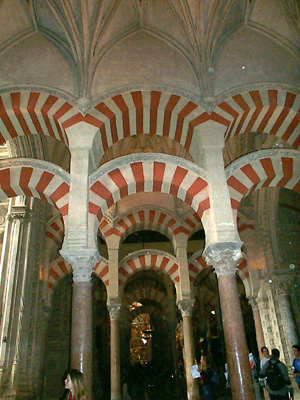
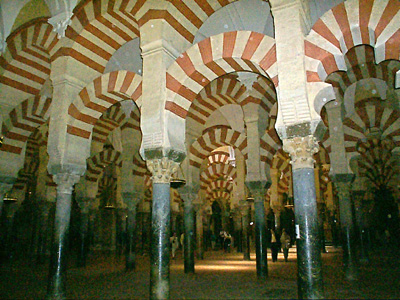
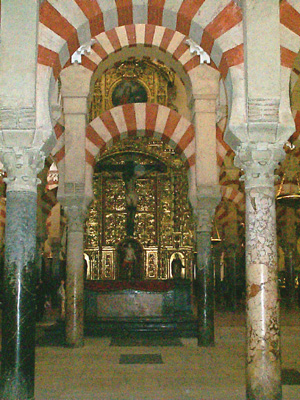
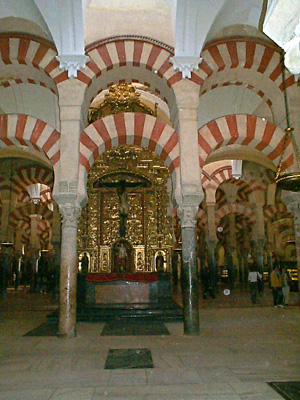
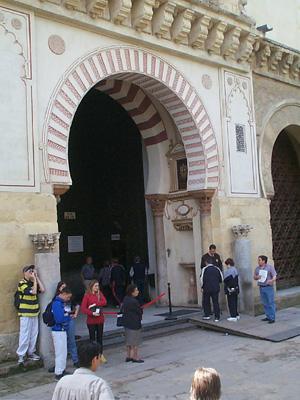
The notion is best exemplified by the magnificent of architecture of the Mesquita, a beautiful former mosque that was once the largest of its kind in the world. This building recalls a time when Cordoba was the capital of the Caliphate of Cordoba, a western arab emirate that had broken free from the rule of the Abbasid Caliphate based in Bagdad.

In tenth century Cordoba it was said:

When Allah was furnishing the empty shell of the world, al-Andalus petitioned for five blessings:

  • clear skies,
  • a beautiful sea bountifully stocked with fish,
  • trees hung with fruit,
  • fair women,
  • and a just government.

Allah granted all but the last wish, reasoning that if all the others
were given a proper government, al-Andalus might rival Paradise.


A little history is in order if you want to fully understand the
amazing scope of the Mezquita. The original Mosque was built in
785-787, soon after the Moorish conquest of 711. Abd al Rahman I wanted
his mosque built quickly, so they used recycled materials from the
former Visigoth church and ancient roman temple formerly on the site –
thus many of the more than 850 columns are of slightly different
heights or materials, and they compensated by slightly burying them or
raising them on pedestals to make the columns uniform. The columns
support the amazing double arches, which dominate the inside of the
mosque. The bottom arches connect the columns, while the top arches
support the roof. The red-and-white color is a result of the building
materials used – sandstone (white) and brick (red). The brick was used
for two reasons – not only is it cheaper than stone, but it also allows
for some give and movement in the case of earthquakes. Later, the
Mosque was expanded several times by Moorish leaders, each time to
accommodate the growing Moslem population of Córdoba. The 10th
Century expansion included the building of the Mihrab, the magnificent
prayer niche whose sea-shell shape provided microphone-like acoustics.
During that renovation, the powers-that-be wanted to show their wealth
and power by making arches of pure sandstone, and just painting them
with the brick pattern so they would match – a bad move, since this was
the area of the mosque that was most damaged by earthquakes in later
centuries.

The final major renovation of the Mosque was the most destructive,
but it also lead to its current role – Roman Catholic Church. After the
Christians re-conquered Córdoba, a small Christian chapel was
built in the Mudéjar style in 1371. But the Bishop of
Córdoba wasn’t satisfied, and he wanted to show the full
strength and glory of the Church, so he petitioned to Charles II
(against the wished of many other church leaders in Córdoba) for
permission to build a cathedral within the walls of the Mezquita.
Having never seen the Mezquita for himself, Charles said “sure, the
church is strong, go for it” (or something like that) and allowed the
bishop to knock out dozens of arches smack dab in the middle of mosque
and start construction on the cathedral. A few years later, when
Charles II traveled to Córdoba to marry Isabella, he saw the
Mezquita with his own eyes for the first time. He realized his mistake
in letting the bishop cajole him into allowing the destruction of such
amazing architecture, but it was far too late. It took 200 years (and
therefore encompasses a wide variety of architectural styles, from
Renaissance to Baroque) but the cathedral-within-a-mosque turned out
pretty good, in the end. Although it is a shame that so much was
destroyed, the exquisite decorations in wood, marble, and gold are
simply breathtaking.

[moor]

…or really really trashy if you want my honest opinion.

Charles himself had complained that the conversion of the Mesquita to a baroque cathedral had destroyed “something unique to build something commonplace.”. Oh well, just another layer to Cordoba’s layer-cake, I suppose.

Any way, it shouldn’t be too surprising to discover that buried under the layers of Christian and Moorish architecture that Roman Cordoba was not just some second-rate provincial capital either but was in fact an imperial city of great prestige and pretention:

Discovered: Europe’s biggest amphitheatre after the Coliseum

Archaeologists
in the Spanish city of Cordoba have uncovered beneath the university’s
old veterinary faculty Europe’s biggest Roman amphitheatre after the
Coliseum.

The find, considered to be “of transcendental importance”, dates
from the first century AD, when Corduba, as it was then known, was the
provincial capital of Betica, today’s Andalusia, in imperial Hispania.
“We initially thought it was a circus, the circular arena the Romans
used for horse races and chariot rides,” says Desiderio Vaquerizo,
professor of architecture at Cordoba University. “But we discovered it
was an immense oval amphitheatre – 178m by 145m and up to 20m high –
that would have been used for gladiatorial contests and other
bloodthirsty spectacles.” The find reveals Cordoba as an imperial city
built in Rome’s image.

“The amphitheatre shows that Cordoba symbolised Rome’s authority in
the west: it was the setting for imperial ceremonies, the place where
the emperor showed himself to the plebs and displayed all his power and
authority before up to 50,000 spectators,” Mr Vaquerizo told The Independent yesterday.

Less than one tenth of the arena is visible, but archaeologists plan
to uncover one sixth of it – 2,000 square metres – in coming years.

The rest of the vast stadium – bigger, more sophisticated and
elegant, than even that at Italica outside Seville – is likely to
remain buried under buildings piled on over the centuries.

In bloodsoaked contests popular between the first and fourth
centuries, gladiators were set against each other, or against lions or
other wild beasts, or – with the huge space flooded with water –
engaged in gigantic naval battles.

Archaeologists have found a plaque marking the seats reserved for a
prominent Cordoban family honoured by imperial Rome. They also found 20
carved gravestones of fallen gladiators, the biggest such collection
outside Rome, prompting experts to conclude that Cordoba was an
important training school for gladiators. “Combatants were between 20
and 25, and their comrades, their concubines or their families carved
epigraphs on stone tablets laid on the graves where the fallen were
buried inside the amphitheatre,” Mr Vaquerizo explained.

The inscriptions record the category of the gladiator, his victories, the laurels and prizes awarded, and the age he died.

Cordoba’s amphitheatre was abandoned in the 4th century, when
Emperor Constantine, influenced by Christianity, banned the murderous
sports as immoral.

Then in 711, Muslims originally from Damascus occupied Cordoba and
for the next 200 years built an entire neighbourhood upon the handsome
curved terraces, plundering the stonework for buildings of their own.
“The discovery is of transcendental importance for the city. It
recovers the importance of Roman games, a key aspect of popular daily
life,” Mr Vaquerizo said. It shows the continuity of mass spectator
sports from the Roman empire to today’s fiestas and bullfights.

“The bullring originated in an amphitheatre; it is the historical thread linking today’s popular fiestas to ancient times.”

The university and the city authorities plan to turn the site into an archaeological park.

[link]

That last remark is so true, the other theme of Cordoba (and of the former Roman provinces generally) is one of continuity. This point was really brought home to me when I visited the ancient city of Nimes in Southern France, home to the best preserved Roman coliseum in the world.

Today it serves as a bull-ring.